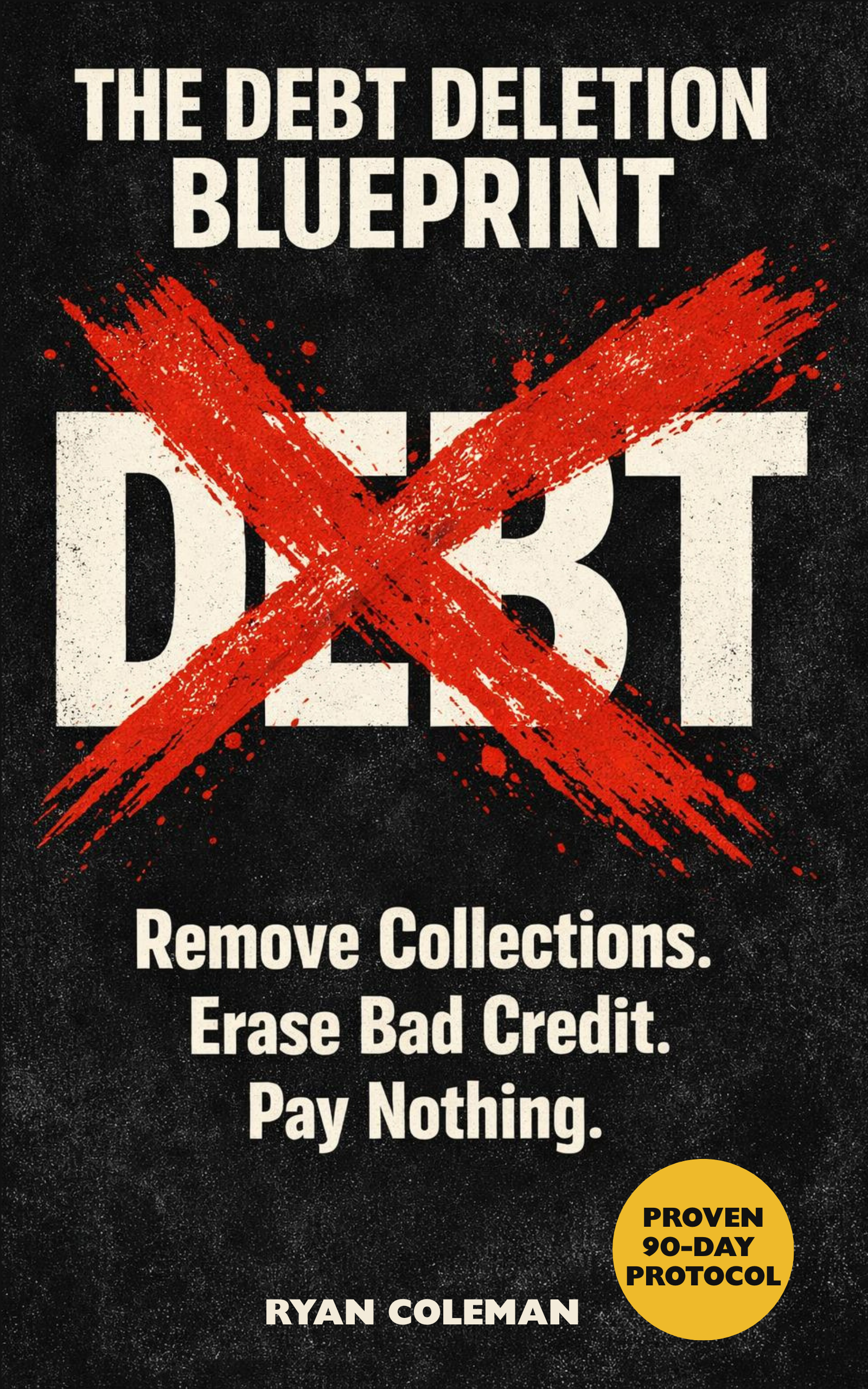
The Debt Deletion Blueprint
Remove Collections. Erase Bad Credit. Pay Nothing.
by Ryan Coleman
They bought your debt for pennies. Make them regret it.
282 pages • kindle, paperback, audiobook
• December 2025
Remove Collections. Erase Bad Credit. Pay Nothing.
by Ryan Coleman
They bought your debt for pennies. Make them regret it.
Debt collection is one of America’s most profitable opaque industries. Collectors buy old debts for pennies—two to three cents on the dollar—and bet you don’t know what federal law lets you do about them.
Most people don’t know they have the legal right to demand validation of any debt. That collectors must prove the debt before continuing collection. That roughly 70% of collection accounts can’t be properly validated. That failed validation creates automatic grounds for deletion.
Most people don’t know they can force deletions through credit bureau disputes. That FDCPA violations carry $1,000 statutory penalties. That CFPB complaints trigger federal investigations collectors desperately want to avoid.
Collectors know all of this. They’re counting on you knowing none of it.
This book eliminates the asymmetry.
Part I — The System (Chapters 1–3). How debt buying works. What the FDCPA, FCRA, and CFPB regulations actually require. Why most collection accounts can’t survive a properly written validation demand.
Part II — The Weapons (Chapters 4–9). Validation demands that trigger the 30-day window. Credit bureau disputes that force investigation. FDCPA violation tracking. Cease-and-desist strategy. CFPB complaints that trigger mandatory federal review.
Part III — The Campaign (Chapters 10–13). The 90-day systematic protocol. Lawsuit defense. Statute of limitations strategy. Pay-for-delete negotiation from a position of strength (30–50% maximum, deletion in writing).
You have collection accounts destroying your credit. Maybe a utility bill from a rental dispute. Maybe a defaulted credit card. Maybe medical debt you can’t even verify. The accounts follow you everywhere: every apartment application, every car loan, every refinance.
This book is for you.
People trying to dodge legitimate debts they can afford to pay. The strategies here are for illegitimate collections, inaccurate reporting, and violations of your federal rights—not for skipping out on money you owe and can pay.
One case study ends badly. Tom Brennan ignored a lawsuit. Default judgment of $7,990, wage garnishment of $840/month for 14 months. His story is in Chapter 11 as a cautionary tale.
Part I — The System
Part II — The Weapons
Part III — The Campaign
Ryan Coleman writes about consumer rights and the debt collection industry. His focus is the information asymmetry that keeps the $13 billion collection industry profitable—and how to eliminate it. Read more about Ryan →
Is this legal advice?
No. This is educational information about consumer rights under federal law. The author is not an attorney. For complex situations—lawsuits, wage garnishment, federal student loans—consult a consumer-rights attorney licensed in your state. The National Association of Consumer Advocates (consumeradvocates.org) maintains a directory.
Does this work in every state?
The federal laws (FDCPA, FCRA, CFPB regulations) apply nationwide. State consumer protection laws add additional rights in many cases. The strategies in this book use federal law as the baseline.
How long does it take to see results?
The book uses a 90-day protocol. Some accounts delete in under 30 days. Some take the full 90. Some can’t be deleted because they’re legitimate, recent, and well-documented—those require a different approach (settlement, payment, statute of limitations strategy).
Do I need a lawyer?
For most collection accounts, no. For lawsuits, wage garnishment, federal student loans, or any situation involving court summons, consult an attorney immediately. The book is explicit about when professional help is required.
Will my results match the case studies?
Results vary. Sarah, Michael, and Jennifer’s outcomes are documented. Some debts delete easily; others require persistent effort; some can’t be deleted. The book is honest about what works, what doesn’t, and what you can realistically expect.